
 Newsletter
 Shop
 Login
 Menü

 Subscribe now


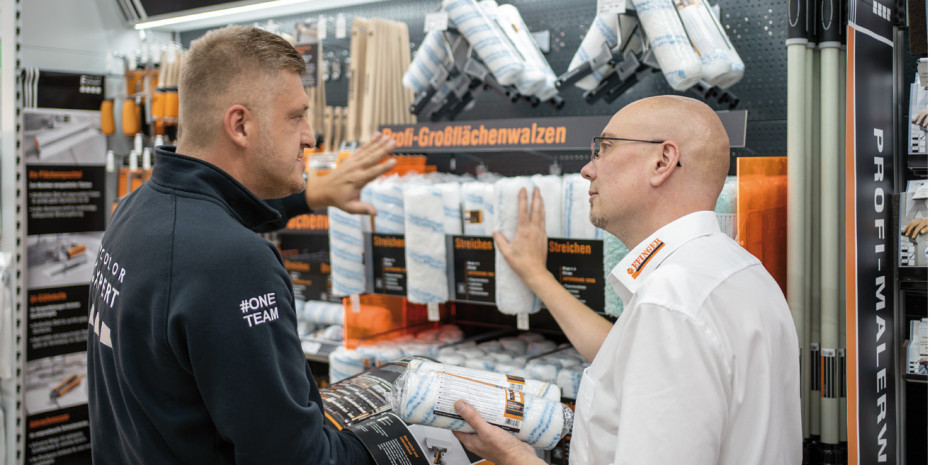
Artificial intelligence can collate information, analyse product ranges and help prepare purchasing decisions. The more commonplace such systems become in the retail sector, the more the question arises: can technology replace people in an advisory role? For Ciret, with its Color Expert division, the answer is clear: AI and digitalisation can speed up processes and support staff. Where experience, practical expertise, trust and the specific market situation count, people remain crucial. Digitalisation does not replace people; it is designed to take the pressure off them.
As part of the internationally positioned Storch-Ciret Group, the manufacturer of painting tools draws on expertise and structures pooled across the group – including in product development, procurement, production, logistics and digitalisation. For Color Expert, these cross-functional capabilities are combined with an understanding of the DIY retail sector and its end customers. Extensive target group analyses, end-user studies, application tests and proof-of-concept tests provide insights into purchasing behaviour, preferences and specific application needs. These insights are incorporated into the further development of products, product ranges and POS concepts.
Furthermore, proximity to individual stores is seen as a key factor for success. Nikolai Joerß, Sales Director DIY Central Europe, is convinced that a good range of painting tools does not sell itself: it must be presented clearly at the point of sale, positioned with specific trades in mind, and understood by shop staff. This is precisely where store support comes into play.
Proximity to the market as a strategic task
Personal support from the company’s own field sales team therefore forms a vital link between head office guidelines and the individual requirements at the point of purchase (POP). “The field sales team knows the stores, the on-site staff and the retailers’ requirements. The aim is not just to sell, but to advise and work with retailers to develop solutions that work at the POP,” explains Joerß.
To this end, Ciret relies on its own on-site staff: Color Expert currently has eight field sales representatives in Germany, as well as one each in Austria and the Netherlands; in addition, there are four in-house merchandisers. The merchandisers implement agreed concepts on the shop floor and adapt them as required. The field sales team is also systematically developed: the team receives training at least twice a year; best practices from the shops are analysed and shared.
The field sales team fulfils a dual role: it brings product, application and POS expertise to the shops whilst simultaneously feeding information back from the shop floor to the company. Customer enquiries, gaps in the product range, changes in purchasing behaviour and experiences with POS concepts are incorporated into sales, product management, application engineering and POS development.
Market support is intended to evolve step by step from the traditional sales role into a holistic partnership – ranging from advice and training, through category management and POS, to secondary placements and performance monitoring. This results in around 12,500 market visits each year.
From product to project
Painting tools require explanation: it is not always obvious to end consumers why one roller, brush or masking product is better suited to a particular application than another. Different paints and substrates place varying demands on the tools.
Joerß is certain that this presents an opportunity for the retail sector: Anyone who provides guidance when selecting tools for a specific project demonstrates their advisory expertise. At Color Expert, they therefore take a project-based approach: what does the customer want to work on – and what do they need to do so? Training shop staff is an integral part of this approach. Newly opened shops receive sales and product training as well as practical application training, which can also be provided directly at the point of sale (POS) upon request.
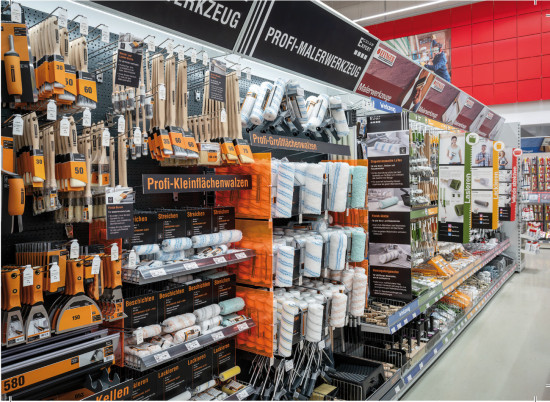
The real test, however, comes on the shelf, the Sales Director emphasises. “Because even the best sales pitch loses its impact if the customer is then faced with a confusing product display.” That is why Color Expert regards the design of the POS as an integral part of customer advice.
The concept is designed to make connections intuitively clear and guide customers to the right tool based on application and substrate. Modules and secondary placements bring together all the products required for a project. “It is crucial not to place additional items wherever there happens to be free space, but within the specific context of use,” explains Joerß. In this way, the POS complements personal advice and, acting as a sort of silent salesperson, takes on part of the guidance role. Colour coding, pictograms and application instructions support this guidance.
The sales expert emphasises that this project-based approach also has an economic dimension for retailers: “A single purchase can turn into a complete application solution – for example, including a roller, brush, masking tape and covering material. Cross-selling and upselling thus arise from providing the full range of equipment required for the specific project. The aim is to combine guidance and the assurance of success for the customer with additional potential for the category.”
Digitalisation frees up time for advice
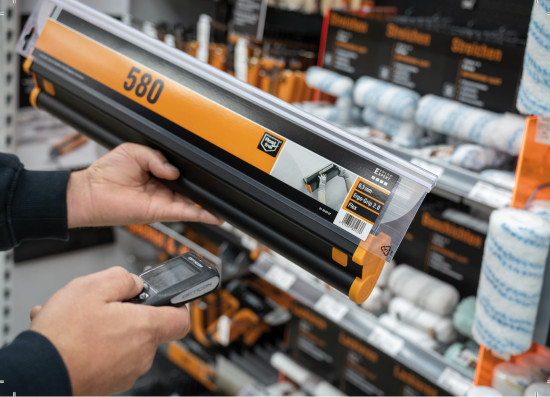
The digitalisation of route planning plays a key role here. Visit frequencies, priorities and available capacities are dynamically linked; visits, tasks and results can be planned and documented digitally. Where a store does not have its own scheduling or ordering system, orders can be recorded on mobile devices and transmitted directly to the ERP system. Furthermore, potential customers can be included in defined visit schedules so that contact does not only begin once a product has been listed.
Ciret also views artificial intelligence in this context as a supportive tool that takes on complex, time-consuming tasks – “not as a substitute for personal customer relationships”. Areas of application include the analysis of large volumes of data, the preparation of customer appointments, product range analyses and the identification of gaps in the product range. The guiding principle is: “We are digitising field service processes so that more time remains for personal support in-store.” Joerß is convinced that empowering staff and developing solutions together remains a personal task.
It is precisely at this interface that the strength of high-street retail becomes apparent: not in pure price competition with online retailers, but where personal advice, direct product experience and concrete support for the specific project come together. “Ciret supports retailers with expert market support, digital tools, application-oriented product ranges and POS concepts that turn individual products into clear project solutions,” explains Joerß.


 Newsletter