
 Newsletter
 Shop
Shop Login
Login Menü
Menü
 Subscribe now



The situation in the home improvement market appears to be at a standstill. After adjusting for inflation, sales in many (European) countries are more or less stagnating – if not actually falling. And it always comes down to price. “The contemporary DIY retail landscape is defined by one dominant force: price.”
So says Thierry Coeman, and he is not just anyone. Coeman is the Belgian industry expert – which means he is by no means familiar only with DIY stores in Belgium. The man has an excellent international network, decades of experience and corresponding insights. And he has courage: not least to spark discussion within the international industry, he has presented “Hammertime²” – a white paper that continues Coeman’s essay “Hammertime”, published in 2021.
The problem with price is: “customers optimise for price, yet expect value-rich experiences.” It is therefore clear that price no longer functions as a differentiating factor. Worse still: in the race to the lowest price, “retail and supply are collectively eroding their future”.
As a solution, Coeman introduces in his new work a literally new term: “Convergion”. This neologism deliberately sets itself apart from „convergence“ – a term that merely describes the obvious, namely „the coming together of channels, value chains and traditionally distinct functions within the ecosystem“. Convergion, on the other hand, does not seek to describe, but rather refers to the conscious shaping of this process, with a shared goal: „meaningful value“.
The Convergion Model, which the author has developed for this purpose, integrates seven dynamics: knowledge, product, service, community, technology, logistics and sustainability. Most remarkable, however, is what lies at the heart of these seven dynamics: the DIY and home improvement store, “the physical and human hub of this ecosystem”.
The fact that the customer journey neither begins nor ends here any longer does not devalue the physical store – on the contrary: because the much-lauded marketplace merely optimises access but creates no differentiated value, it is not the solution. For Coeman, the solution lies in Convergion, which “shifts DIY retail from selling products to orchestrating outcomes across the entire value chain. This transformation inevitably reshapes the role of the physical store itself.”
And what does this store look like? Coeman’s answer can be summed up in one word: human. For him, it is not primarily about the format, but about this principle: “The physical store is above all a people business.” Of course, even in a market built on the Conversion model, products are presented and transactions carried out. But its relevance lies “in its ability to create trust, empathy, reassurance and meaningful support throughout the customer journey” – and this is not in contrast to, but in harmony with digital content, which is so important, particularly for younger target groups.
Of course, the author does not turn a blind eye to how different (and large) DIY stores are and need to be. Yet for him, it is not the format but the function that takes centre stage: “Smaller stores, focused on proximity, service, interaction and engagement […] Larger stores are focused on exploration, fulfilment and scale.”
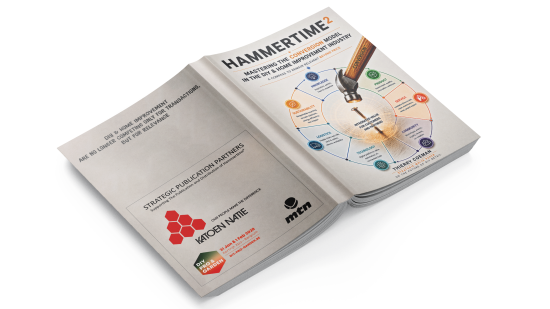
In Coeman’s Convergion model, none of this is a matter that concerns only the retail sector. He brings suppliers into the picture as crucial partners. Much has already been written about this partnership. Coeman knows: it is usually reduced to both sides negotiating margins, terms, volumes and promotional contributions – in short, a transaction. The Convergion model aims to think further ahead: “The question is no longer how value is divided, but how value is created,” writes Coeman. Specifically: “How can retailers and suppliers grow the total value pool together, rather than compete for its distribution?” This new collaboration focuses on four key points: greater transparency, closer alignment of objectives, more agile forms of cooperation and a mutual focus on creating continuous added value for the end-user.
In this context, Coeman inevitably takes a critical look at the role of private labels. For him, it is clear: “Strong brands, particularly manufacturer brands, remain one of the most powerful sources of differentiation in retail, capable of building recognition, trust and long-term customer loyalty.” However, if the strategic roles within the brand architecture are correctly allocated, both private labels and A-brands contribute to differentiation. In this context, the author also highlights the now crucial role that data plays in value creation. In the Convergion model, data is a “shared asset, supporting better decision-making, improved customer understanding and more effective collaboration”.
When retailers and manufacturers create value together, the question arises as to how that value should be shared. Here, Coeman addresses the topics of communication and pricing strategies (Everyday Low Price vs. High-Low pricing strategies). In the Convergion model, it is clear: “If value is created differently, it must be measured and monetised differently.”


The author devotes a separate chapter to the topic of sustainability. He sees it not as an obligation, but as an opportunity that must be integrated throughout the entire value chain. The fact that an entire industry, very much in the spirit of Convergion, can tackle this issue together is demonstrated, among other things, by the international associations Edra/Ghin and Hima with their “Make It Zero” initiative.
The question remains: how can this vision of Convergion be implemented in the day-to-day operations of the DIY sector? By ensuring that not only the major players on both sides of the market – retailers and manufacturers – cooperate with one another, but that there is also collaborative working within the individual companies on both sides. The shift in mindset required for this must, of course, start at the top. And so Coeman concludes with six priorities for management teams, which are perhaps best summarised in priority number six: “Encourage experimentation and reinvention.”
For this also encapsulates the central concern of Hammertime². As a white paper, this work does not aim to provide ready-made or definitive answers, but rather to spark a discussion – ideally across the entire industry: “It is a framework for thinking, and a guide for action. A compass rather than a prescription.”
After all, anything else would have contradicted the very idea of Convergion.
Rainer Strnad


 Newsletter