 Newsletter
 Shop
Shop Login
Login Menü
Menü
 Subscribe now


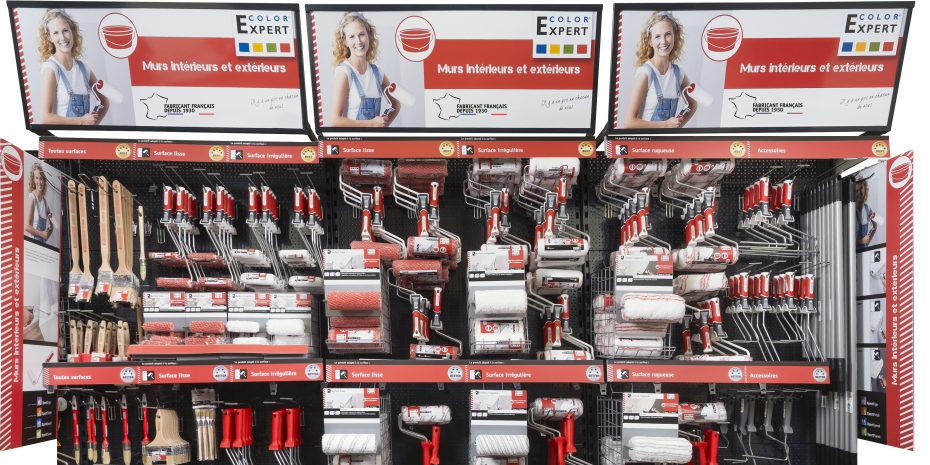
For Color Expert, Europe is not a homogeneous market. It is multifaceted, has evolved historically and varies greatly in its requirements: Retail structures, colour systems, user habits, climatic conditions and regulatory requirements vary from country to country. At the same time, many DIY retail organisations operate internationally and expect solutions that work across national borders. This is precisely where Color Expert comes in – with a clear brand and product range strategy, a close understanding of local markets and the ability to implement concepts in terms of both production and regulatory compliance.
What strategic significance does Europe hold for Color Expert today?
Nikolai Joerß: For us, Europe is far more than just a sales market – it is the foundation for our growth and for further developing concepts across national borders. Many retail companies operate internationally and expect professionalism, consistency and scalability – but not as a one-size-fits-all solution, rather with an understanding of the respective markets.
Vera Mikosch: For the Storch-Ciret Group, the advantage lies in combining the strength of a European organisation with an understanding of local markets. In France and Spain in particular, it is clear that retail landscapes and product range preferences function differently to those in Germany or Poland. Developing concepts that are viable across Europe whilst understanding what is needed locally – that is the core of our work.
Does that mean you’re continuing to focus on growth in Europe? Where do you see the greatest potential?
N. J.: Yes, absolutely! We see the greatest potential where we can contribute our expertise even more strongly as a category partner to the retail sector – with comprehensive solutions covering product range, POS concepts, packaging, logistics and category management.
V. M.: As well as expanding Color Expert, we see great potential in bespoke private-label concepts. Many retail companies are looking for clear differentiation. With tailor-made product range and POS concepts, technical validation in collaboration with the paint industry and our own manufacturing facilities, we can create real added value here.
Europe is not a uniform market. What makes this diversity particularly exciting – and challenging?
Philipp Escher: At heart, DIY enthusiasts are more similar than one might think: they’re looking for guidance, want to find the right product for their project and ultimately achieve a good result. At the same time, there are preferences that need to be understood in detail. In France, for example, distinctions are made much more on the basis of the finish. A textured fibreglass wallpaper isn’t regarded there as ‘rough’, but rather falls within the category of smooth surfaces – albeit with different requirements for the finish. You can only understand that if you really delve deep into the market.
N. J.: Europe is significantly more fragmented than other major markets. In the US, there are more uniform distribution channels and fewer product preferences that have developed over time. In Europe, for example, we have different brush shapes, roller widths and core systems. A supplier must not only understand this conceptually, but also be able to put it into practice.
Our production structures are tailored precisely to this diversity – this enables us to implement concepts more quickly and in a way that is more in tune with the market.

Mr Joerß, you are responsible for the DACH region and Poland. How different do you find these markets?
N. J.: In the German-speaking region, we encounter professional retail organisations with a high level of product range expertise – the focus is on efficiency, space productivity and consumer orientation. Poland, by contrast, is a dynamic market with intense competitive pressure. Painting work there is often carried out by all-round tradespeople who also cover drywall installation and renovation. The traditional specialist paint trade is less prominent; many users buy from building materials suppliers or directly from DIY stores. For us, this means consistently developing product ranges from an application perspective. Customers must be able to see straight away which tool suits which paint and which project.
Ms Mikosch, what are the distinctive features of the French and Spanish markets?
V. M.: France and Spain are large countries where local supply networks play an important role – private and professional users often source products from the same outlets. In France, the proportion of professional painters is high, whilst Spain is characterised more by all-round tradespeople. This influences how product ranges need to be structured: a professional painter views a tool differently from someone who covers several trades.

How much consistency does a brand like Color Expert need across Europe?
N. J.: A strong brand needs a clear core. Customers and retail partners must be able to recognise Color Expert everywhere – this builds trust and facilitates collaboration with internationally operating retail companies. However, consistency does not mean treating every country the same. We define central standards for the brand, product range and POS – whilst at the same time allowing sufficient flexibility for local requirements.
V. M.: In Spain and France, the importance of centrally selected products is growing. A large proportion of the product range stems from European tenders or centrally managed processes. A clearly positioned brand such as Color Expert has distinct advantages across national borders in this regard.
From a product range management perspective, where does the necessary local adaptation begin?
P. E.: Local adaptations begin where local habits dominate. From a purely German perspective, we do not automatically achieve the best results. In other countries, there are products and methods of application that solve the DIY enthusiast’s problem at least as well. We can learn from this – without uncritically adopting every local peculiarity.
What influence do local characteristics have on your product range design?
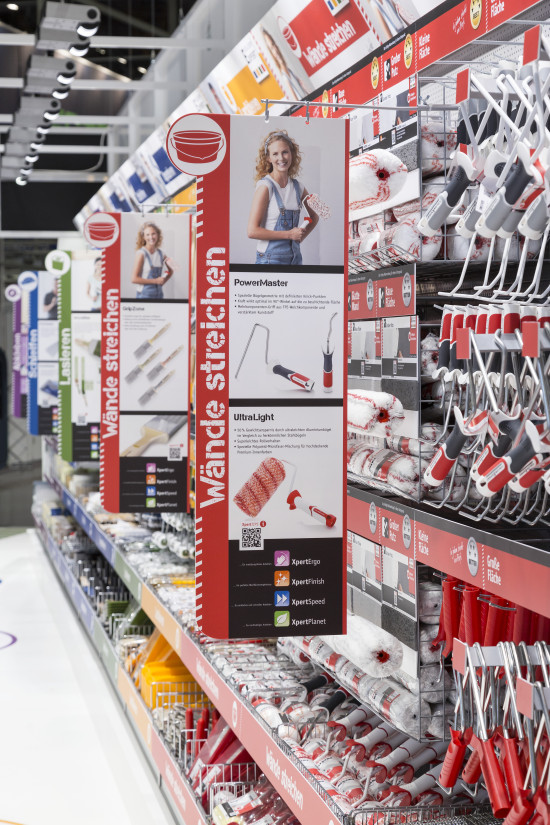
N. J.: The differences are very specific: core systems for paint rollers, roller widths, brush shapes, bristle lengths. In the UK, the brush traditionally plays a much more significant role than the roller. Less masking tape is used, and edges are more often painted directly with a brush – this places particular demands on brush quality and bristle finish. Added to this are climatic differences: in coastal regions, salt and sun affect coatings differently than in Central European markets.
V. M.: In Southern Europe, the craft of painting with brushes has a long tradition. In France, there is the ‘Réchampir’ – a round brush with a tapered head for precision work. In Spain, there’s the ‘Cabolata’, an oval brush with a voluminous bristle head for high paint absorption. Some of these country-specific designs have been incorporated into the Color-Expert concept.
P. E.: Another example: Washi masking tapes originate from the French-influenced region and are now also used in Germany – on delicate wallpaper or freshly painted surfaces. In Eastern Europe, black paintbrush bristles are difficult to market because light-coloured bristles are more strongly associated with quality. Such details can be decisive for the acceptance of a product range.
How do you ensure that your approach to guaranteeing success also works across Europe?
V. M.: For us, the focus isn’t on the tool itself, but on the paint. Paint systems, manufacturers’ market shares and container sizes vary considerably from country to country – and this has a direct impact on the requirements for the tools. That’s why we never develop product ranges in isolation, but test products in collaboration with paint manufacturers. This is the only way to create concepts that truly suit the target audience and the retailer’s positioning.
How important are own-brand and private-label concepts in the European DIY retail sector?
N. J.: Own-brand products play a central role in many European markets – but the requirements have become significantly more demanding. It is no longer just about price, but about clear positioning within the category. An own-brand must provide guidance, build trust and help the retailer stand out from the crowd.
V. M.: This is precisely where one of our strengths lies. We develop bespoke private-label concepts tailored to the retailer’s brand, target audience and positioning – not off-the-shelf solutions. This results in concepts that offer genuine added value to the end consumer whilst simultaneously supporting the retailer’s differentiation.
How does knowledge transfer work between the countries and head office?
N. J.: Knowledge transfer is a key success factor for us. Our country managers act as the link between the market and the organisation: they are familiar with local retail requirements, the competitive landscape and changes in consumer behaviour. Their insights feed directly into product ranges and POS concepts. And we systematically share successful projects so that good ideas can be quickly rolled out in other markets too.
V. M.: This is particularly relevant for German DIY store organisations with international operations. We do not simply export a German concept, but advise on how it needs to be implemented locally – whether in the Czech Republic, Poland, Spain or France.
P. E.: A European perspective helps us to recognise differences and decide whether we need to take them into account. Sometimes you’re surprised at how similar the markets are at their core. And then there are details that can make all the difference. You can only spot these when you’re on the ground – not from behind a desk.

What role does product compliance play in this European market development?
N. J.: Product compliance is becoming increasingly important for the retail sector. Requirements in Europe are growing more complex – this applies not only to the product itself, but also to packaging, labelling and the way products are placed on the market. As a company headquartered in Europe, we can integrate these requirements at an early stage into product development and product range solutions. This provides additional reassurance for retail partners.
In your view, what is the key to successfully developing the European market in the long term?
P. E.: It’s the combination of centralised standards and flexibility in implementation. Neither pure standardisation nor pure localisation works in the long run. Ultimately, a supplier has one key task: to deliver. If service levels, availability or pricing aren’t right, you’re quickly out of the running. Successful market development isn’t a one-man show – what lies behind it is crucial: sales, product range management, product development, production, logistics, compliance and category management.
What role should Color Expert play in Europe over the next few years?
V. M.: We want to further develop Color Expert as the leading DIY brand for painting tools in Europe – with a consistent brand image, innovative products and solutions that make it easier for consumers to choose the right products. Our aim is to be the partner that combines innovation, in-house manufacturing expertise, category management and excellent point-of-sale concepts. When retailers in Europe think of modern painting tool concepts, Color Expert should be the first port of call – both as a brand and for bespoke private-label concepts.
What is your outlook for the future – particularly with regard to German DIY store decision-makers?
N. J.: For German DIY store decision-makers, our European approach offers tangible added value. Many retail companies have long been thinking beyond national borders. They need partners who understand local requirements, can adapt concepts and still deliver reliably, scalably and competitively. That is precisely what we aim to do.


 Newsletter