
 Newsletter
 Shop
 Login
 Menü

 Subscribe now


What was the starting point for the further development of your painting tools department?
Marco Stenzel: We were no longer entirely satisfied with the breadth of our product range and could no longer serve our tradespeople and small-scale tradesmen as well as we would have liked with our previous supplier.
The Eurobaustoff trade fair in 2025 proved to be the deciding factor: at the Ciret stand, I was honestly surprised by how the company had developed in terms of quality, depth and breadth of its product range. The professional range, in particular, won us over. In the spring, we completely revamped the department just in time for the start of the season.
How important is regular, personal support from a manufacturer’s sales representative to you?
Stenzel: There are product ranges where support from a sales representative is essential – and, for me, painters’ tools are one of them. It’s important that someone visits regularly, introduces new products, trains my staff and acts as a dedicated point of contact should any problems arise. Ciret was already visiting us regularly even before we became a customer. That builds trust. At the same time, the quality of support in the industry is generally declining; which is why I value suppliers with their own sales force all the more.
Slawomir Blanik: For me, personal contact is the foundation of good cooperation. On site, we see things that sales figures alone don’t reveal: how a product range is presented and where staff need support. We don’t just want to sell and take orders, but to advise and develop solutions together with retailers. We see this as teamwork.
In which areas do your staff at Malerwerkzeug particularly need support and specialist knowledge?
Stenzel: Our staff need to know which brush and which roller are suitable for which paint and which surface. Only then can they confidently pass this knowledge on to the customer. That’s why training is so important – ideally right there at the shelf.
Blanik: Our product range is grouped by surface type – smooth, rough, coarse. The key factors are: what does the customer want to paint, and what type of surface do they have? That’s exactly what we train our sales staff on, right there at the shelf. The DIY customer doesn’t need technical details such as pile height or pile length. They need the right product for their project – and the staff member must think through the entire project.
What specific changes have been made to the product range, shelving layout and secondary placements?
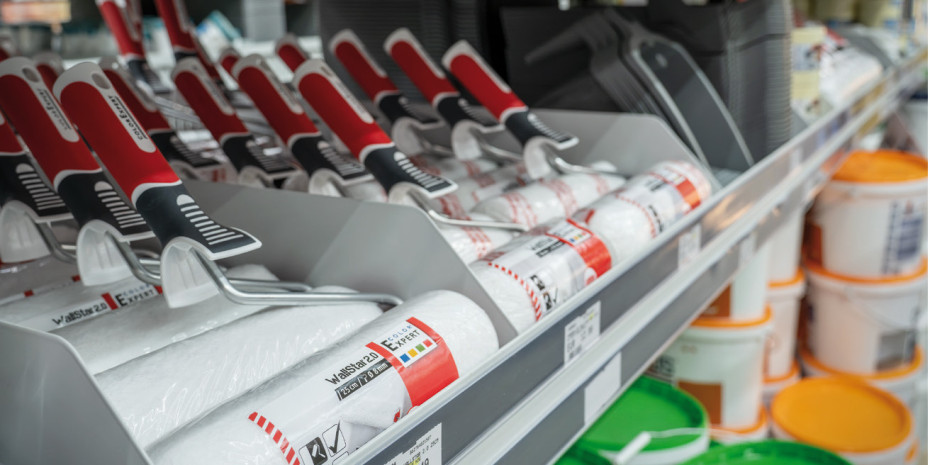
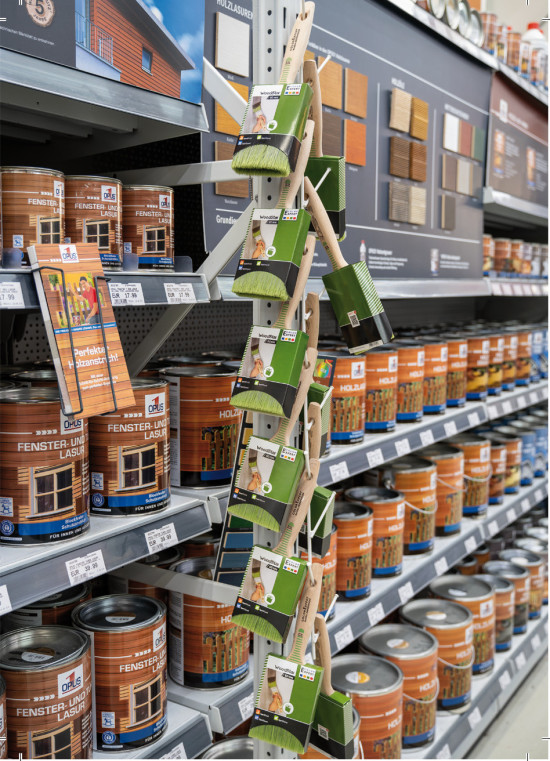
Stenzel: We’ve added masking tape, rollers and brushes to complement the emulsion paints; and for varnishes and wood stains, the appropriate brushes and painting kits. On the display rack with the emulsion paints, customers can find everything in one place, from protective sheeting to rollers and brushes. We didn’t have these consistently coordinated secondary placements before.
Blanik: For us, the POS is the silent salesperson. No shop assistant can advise every customer personally. That’s why the concept must take the lead at the shelf and guide customers to the right product as easily as possible. We use secondary placements where they make sense in the context of the customer’s project. In Trossingen, for example, we place some of our products in the checkout area – in case a customer has forgotten something.
What impact have you observed on purchasing behaviour – and are there any measurable results yet?
Stenzel: Customers are responding well to the secondary placements. After five or six months, it’s still too early to draw a definitive conclusion, particularly as we’re seeing a general reluctance to spend. We’ve managed to maintain turnover in this area and increase our margin. We’ll be able to draw a reliable conclusion after a year.
Blanik: For us, the potential lies not just in selling a single product, but in supporting the customer throughout their entire project. A single purchase can thus give rise to a need for a complete solution – for us, cross-selling means helping the customer to fully equip their project.
Where can AI provide useful support in the market – and where does personal advice remain indispensable?
Stenzel: The clear advantage of high-street retail is the personal service provided on the premises. The customer can touch the goods and take them away immediately. For customers who speak a foreign language, a real-time translation module would be a great help. An automatic re-ordering system could also free us up to focus on what really matters: advising customers.
Blanik: Personal advice remains indispensable wherever experience, trust and the specific situation on the shop floor play a role. AI can make a recommendation, but it cannot replace a conversation between people. We already use AI in route planning. It is intended to support people, not replace them, and free up more time for the actual work in the shop.
What advice would you give to another shop manager who is considering investing more heavily in the quality of advice, product range structure and POS?
Stenzel: Just go for it – even if you have reservations at the start. In brick-and-mortar retail, we need to keep evolving and offer a shopping experience: with appealing presentation, availability, a wide selection and good advice, so that, for example, people who are less skilled at DIY can be empowered to do things themselves.
This is the only way we can set ourselves apart from online retailers and discounters. After all, anyone can offer low prices these days.
Blanik: That’s exactly where we want to support retailers. Good advice and clear point-of-sale displays give customers guidance and confidence when choosing products. Ultimately, what matters is that they find the right materials and can carry out their project successfully.


 Newsletter