
 Newsletter
 Shop
Shop Login
Login Menü
Menü
 Subscribe now



A shortage of skilled staff, a constantly expanding product range and a customer base that expects answers even on a Sunday morning: the DIY retail sector is under pressure, explains Homie AI. The technology company steps in where it’s become virtually impossible to provide consistently high-quality advice across tens of thousands of products on a day-to-day basis – particularly during peak seasons when staff are stretched to the limit.
From bottleneck to solution
Homie AI develops AI-powered advisory and sales assistants for retail and industry. The idea is to create a digital colleague who answers recurring questions round the clock, thereby taking the pressure off specialist staff. The assistant does not operate as a rigid system, but responds on a case-by-case basis: one customer may simply want to know where to find an item, whilst another may want a detailed explanation of their project. Today, Homie AI’s assistants advise more than 50,000 end customers every day across twelve European countries. Its client base includes several retailers from the DIY and gardening sectors, including Hornbach, Bauhaus, Hagebau and Pflanzen-Kölle.
Advice across all channels
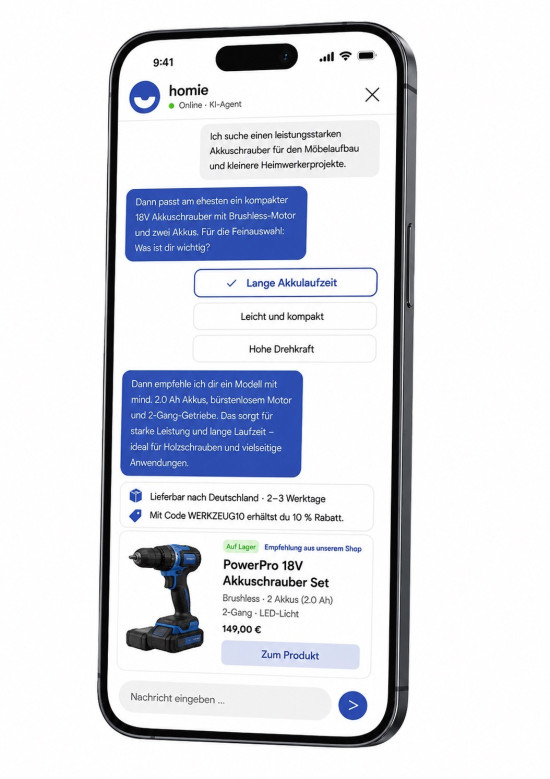
Cross-channel advice is crucial, the provider emphasises: in the online shop, the assistant responds in real time, recognises the page being viewed and switches automatically between product, category and service enquiries. In brick-and-mortar shops, it is used via self-service terminals in-store, via mobile devices for staff on the shop floor, and via a QR code that customers can scan with their own smartphone without having to install an app. The aim is to ensure that customers receive the same advisory experience whether they are at the shelf, in-store or at home.
A real-life example
The example of a major DIY store operator illustrates how this can be implemented in day-to-day business operations. The company initially introduced the assistant as part of a pilot project in 15 stores and subsequently rolled it out across several regional markets. The assistant answers the most frequently asked questions via self-service, such as the location of an item, its availability or whether a product is suitable for a particular project. This frees up the specialist advisers’ time for more complex enquiries, such as a bathroom refurbishment. Those involved described the early involvement of staff as key to success, as the assistant is intended to make their work easier, not to replace them.
Conversations turn into knowledge
Every conversation also provides actionable insights. An AI-powered analysis summarises every conversation and categorises it by topic, tone and keywords. Across tens of thousands of dialogues, this reveals what customers are asking for, which product ranges are growing in demand, where processes are faltering, and how satisfied customers are with the answers they receive. This analysis can be used to fill knowledge gaps and inform decisions on product ranges, pricing and advertising.
Homie AI views the solution as an ongoing process and continues to develop the product in close alignment with customer needs. The assistant learns from every interaction, with new features emerging from observed user behaviour. The company was founded in Germany, has offices in Hamburg and Cologne, and integrates with all standard shop systems without the need for programming.


 Newsletter