
 Newsletter
 Shop
Shop Login
Login Menü
Menü
 Subscribe now


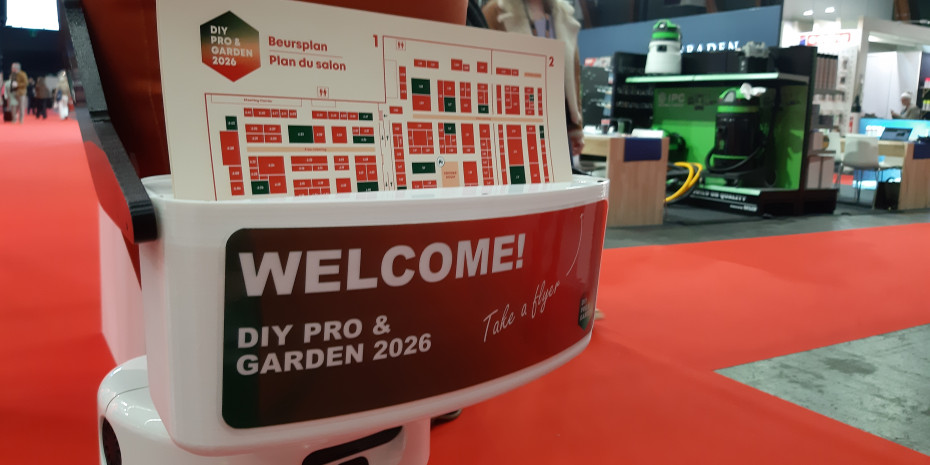
With an ambitious theme, the DIY, Pro & Garden trade fair in Kortrijk has underlined its claim to be more than just a regional event of significance for Belgium or the Benelux region: How should the industry deal with technological transformation, retail technologies, and data?
This was the focus of the lecture and seminar program at the two-day event at the end of January, which was held in English with international visitors in mind. After all, there were also international brands and foreign companies among the 145 exhibitors. A separate country pavilion was set up for Italy.
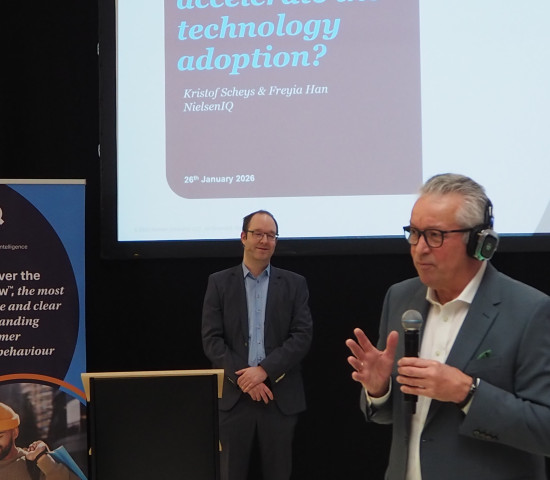
As part of the trade fair, a study by Nielsen IQ was presented exclusively for the first time, which examined the Belgian industry's stance on the use and, above all, the exchange of data between retailers and manufacturers. Market researchers Kristof Scheys and Freyia Han noted that retailers and suppliers certainly see the advantages that exchanging data on customer behavior brings to both sides. However, both sides also cited a number of obstacles; for example, there is no consensus on the benefits in relation to the investment. The study was supported by the three leading Belgian DIY store groups Brico (Maxeda DIY Group), Hubo, and Gamma.
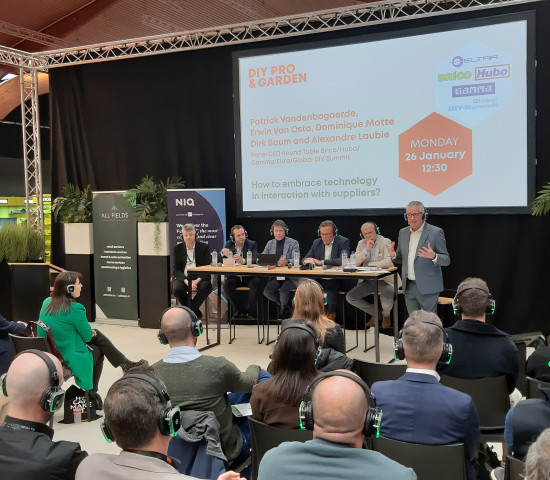
This topic was followed by a panel discussion with prominent participants, moderated by Belgian industry specialist Thierry Coeman, who was responsible for the lecture program and summarized the issue as follows: Should only retailers have access to market data, or does it pose a risk if this data is not shared? This was discussed by Brico CEO Patrick Vandenbogaerde, Hubo owner Erwin Van Osta, Gamma CEO Dominique Motte, Alexandre Laubie, formerly of Leroy Merlin and now of Global DIY Summit, and, on the manufacturer side, Dirk Baum, CEO of Eltra and president of the manufacturer association Hima Benelux.
Transparency on both sides?
The topic of discussion proved to be an important aspect of the question of how far the partnership between industry and trade goes. Erwin Van Osta insisted unequivocally that retailers should share data that leads to operational improvements, for example in logistics, with their suppliers – and they already do so – but not data on customer behavior and checkout data. Like his fellow panelists from the retail sector, the Hubo CEO considers this data to be strategically relevant in competition. Conversely, retailers called for transparency on the part of manufacturers regarding their production conditions.
Björn Thys from Proximus NXT, Thierry Maubax from AI Compass, and Jeroen Lauwers from Delihome also addressed various aspects of technological solutions in retail. University lecturer Pieterjan Bonne contributed another aspect: How can humanity be reconciled with technological acceleration?
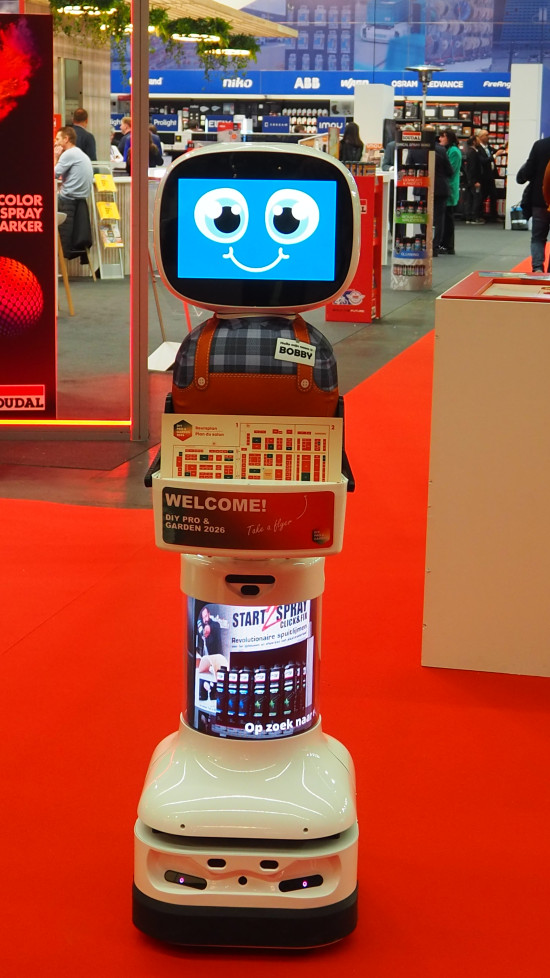
With so much technology on display, a real robot was a must: the device developed by Deduco called Bobby – which managing director Tom Dujardin also presented in one of the lectures together with Martijn von der Sluijs from Bolton Adhesives – greeted visitors at the entrance to the trade fair.
Rainer Strnad
The Belgian market
DIY stores in Belgium ended 2025 with a decline in sales. Last year, they generated 1.2 percent less revenue than in 2024. In contrast, Belgian garden centers increased their sales by 3.8 percent. These figures were announced by Kristof Scheys from Nielsen IQ (GfK) at DIY, Pro & Garden.
The DIY & Garden Panel, in which market researchers track 78 product groups in the home and living sector, declined by 3.2 percent in Belgium. Vervekke explained that this was due to the large-scale DIY store sales channel. In other large-scale distribution channels, business with these products developed positively.


 Newsletter