
 Newsletter
 Shop
Shop Login
Login Menü
Menü
 Subscribe now


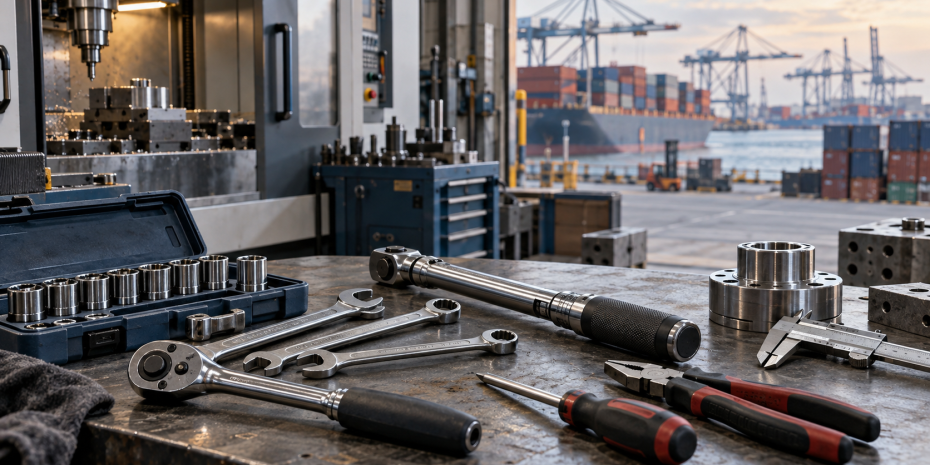

Taiwan’s hand tool industry is characterised by its strong export orientation. From the perspective of Taiwanese manufacturers, the target markets have different profiles.
The bulk of exports goes to the US market. This high US market share underscores the sector’s close integration with North American professional, industrial and home-improvement supply chains, whilst Europe remains an important destination for higher-specification products.
The most recent figures are from 2025. These figures indicate a more challenging demand environment. Taiwan’s worldwide hand tool exports totalled USD 3.596 bn (EUR 3.117 bn) in January–December 2025, a year-on-year decline of 4.92 per cent. Exports to the United States fell by 2.73 per cent to USD 1.557 bn (EUR 1.349 bn), whilst exports to the EU-27 plus the United Kingdom decreased by 9.49 per cent to USD 792.7 mio (EUR 687.0 mio). In contrast, exports to the ASEAN-10 countries, plus Japan, South Korea and India, rose by 3.02 per cent to USD 454.4 mio (EUR 393.8 mio). Despite the decline in export value, the global average unit price increased by 1.59 per cent to USD 14.70 per kilogram, suggesting a continued focus on product mix and value rather than volume alone.
Another characteristic of Taiwan’s hand tool industry is its geographical concentration. The industry is heavily concentrated in central Taiwan. Taichung and the neighbouring areas of Changhua and Nantou form a dense production ecosystem, whilst the greater Taichung area is widely recognised as the core of the cluster. Manufacturers and specialist suppliers are located along Taichung’s Provincial Highway 74 and across districts including Wufeng, Taiping, Dali, Dadu, Wuri and Longjing. This proximity facilitates rapid coordination amongst firms specialising in forging, die and mould making, heat treatment, machining, surface finishing, electroplating, assembly and packaging.
In 2022, Taiwan had 2,369 hand tool businesses employing roughly 48,000 people; more than 90 per cent were small and medium-sized enterprises with fewer than 50 employees, and more than 70 per cent were located in central Taiwan.
Within the industry, this concentration is seen as one of its major advantages. The industry combines specialised process know-how with flexible, finely divided production. This structure enables manufacturers to serve customers seeking both high-volume production and high-mix, low-volume orders. Furthermore, as is emphasised in Taiwan, there is reliable access to domestic steel and a long-established base of metalworking capabilities.
Taiwan’s hand tool producers have historically worked with global brands through OEM manufacturing, whilst a growing number have moved towards ODM capabilities by taking on product design, engineering, testing and differentiated product development. The industry has also been shifting from consumer DIY applications towards professional and industrial-grade tools, including automotive repair equipment and digital torque-management products. The industry’s own assessment of this trend is as follows: ‘This upgrading trend supports higher value-added offerings and helps firms address more demanding requirements for ergonomic design, accuracy, traceability and service life.’
This industry overview is compiled from public information published by the Metal Industries Research & Development Centre (MIRDC), TAITRA, the Taichung City Government and Taiwan's New Southbound Policy Portal. The TiTE x IHT trade fair, co-organised by Lanza International Co., Ltd and the Taiwan Hand Tool Manufacturers' Association, will take place from 20 to 22 October 2026 in Taichung – right at the heart of Taiwan's hand tool industry.
Ad by TITA


 Newsletter