
 Newsletter
 Shop
 Login
 Menü

 Subscribe now


Average per capita purchasing power in Europe will increase noticeably in 2026. However, the differences between the 42 countries examined for the ‘NIQ Purchasing Power Europe 2026’ study remain considerable.
In total, the purchasing power of Europeans in 2026 will amount to around 14.5 trillion EUR. This budget is available for expenditure in areas such as housing, consumer goods, services, energy, mobility, private pension provision and leisure. In mathematical terms, this corresponds to an average purchasing power of 21,153 EUR per inhabitant. Compared with the revised figure for the previous year, this represents nominal growth of 4.4 per cent
As in previous years, Liechtenstein will once again top the European purchasing power rankings in 2026. Liechtensteiners have a per capita purchasing power of 78,520 EUR, which is 3.7 times the European average. Switzerland and Iceland follow in second and third place respectively. Whilst the per capita purchasing power of the Swiss, at 54,730 EUR, is around 2.6 times that of the average European, Icelanders have 44,692 EUR per capita at their disposal. This means that per capita purchasing power in Iceland is more than double the European average.
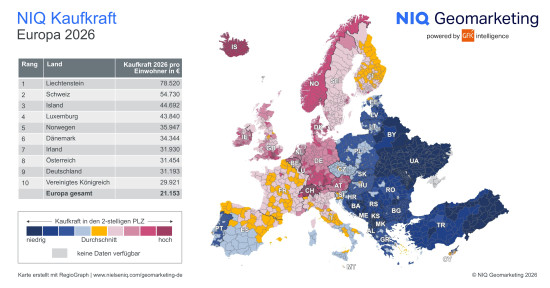
The other countries in the top 10 also have a per capita purchasing power that is significantly above the European average. Germany remains in ninth place with a per capita purchasing power of 31,193 EUR.
In total, 17 of the 42 countries surveyed are above the European average. In contrast, 25 countries have below-average per capita purchasing power. Ukraine continues to occupy the bottom position in the ranking. There, purchasing power stands at just 3,456 EUR per inhabitant, amounting to around 16 per cent of the European average.


