
 Newsletter
 Shop
Shop Login
Login Menü
Menü
 Subscribe now



- Retailers and suppliers: exclusive insights
- Market analyses and country reports
- Trends in the DIY and garden market
- Latest news and archive
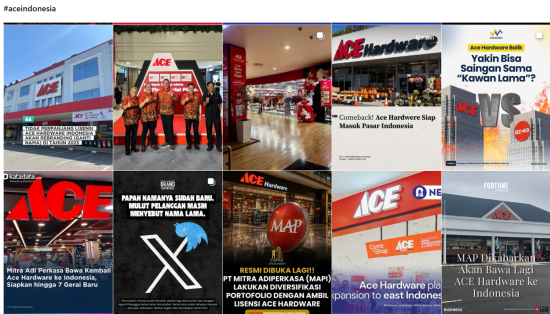
Market analysts are bullish over the return of “the helpful place”, which is now partnered with publicly listed PT Mitra Adiperkasa Tbk (MAP), one of the top retailing conglomerates in Indonesia. The local company - which has a retail exposure that spans more than 175 midmarket to upscale brands across seven categories and 4,192 stores in seven countries - has been getting "buy" recommendations over its decision to bring back Ace.
On its part, MAP has been working to rebuild the brand’s presence. Apart from the physical store openings, the conglomerate is drumming up the brand’s return to the virtual space by reactivating the old e-commerce platform of Ace Indonesia, www.acehardware.id. It has also gone back to social media, opening accounts on Instagram, Facebook, Tiktok, and X (formerly Twitter).
Returning to a different ballgame
But amid the warm reception for the return of a well-loved brand, Ace Hardware has realities to contend with. While it was away, the Indonesian market shifted and the void that the retailer left was filled immediately. Azko, the company that rose from the rubble of the terminated partnership between Ace International and the Kawan Lama Group, now has a hold - albeit a more tenuous one - over the Indonesian home improvement market, with around 300 stores across the whole archipelago. Most of these stores are converted Ace Hardware outlets, allowing Kawan Lama’s own brand to attain national coverage almost instantly while also securing prime locations.
Meanwhile, Asian retailing giant Mr. DIY has been making enough of an impact on the value segment of the Indonesian home goods sector for the market leader to take notice. Azko created a new brand, Neka, in a bid to challenge the control of Mr. DIY in that segment.
Apart from Azko and Mr. DIY, local home improvement players Depo Bangunan and Mitra10, which are backed by Thai conglomerate Siam Cement Group, also hold their own in the Indonesian home improvement market.
"Ace’s reentry comes at a much more challenging time than when the brand first operated in Indonesia. The market is now significantly more competitive, with Azko and Mr. DIY already having established nationwide store networks, supply chains, and loyal customer bases," Jason Tjiptadi, senior consultant at market intelligence company Euromonitor International, said in response to questions sent by DIY…


 Newsletter